

Decoding Science 015: AI Replicating a Published Study in under an Hour and Biophotonics Emphasizing the Gap between Copying and Understanding Biology


Welcome to Decoding Science: every other week our writing collective highlight notable news—from the latest scientific papers to the latest funding rounds in AI for Science —and everything in between. All in one place.

What we read
The 100x Research Institution [Andy Hall, Free Systems, Jan 2026] (HJ)
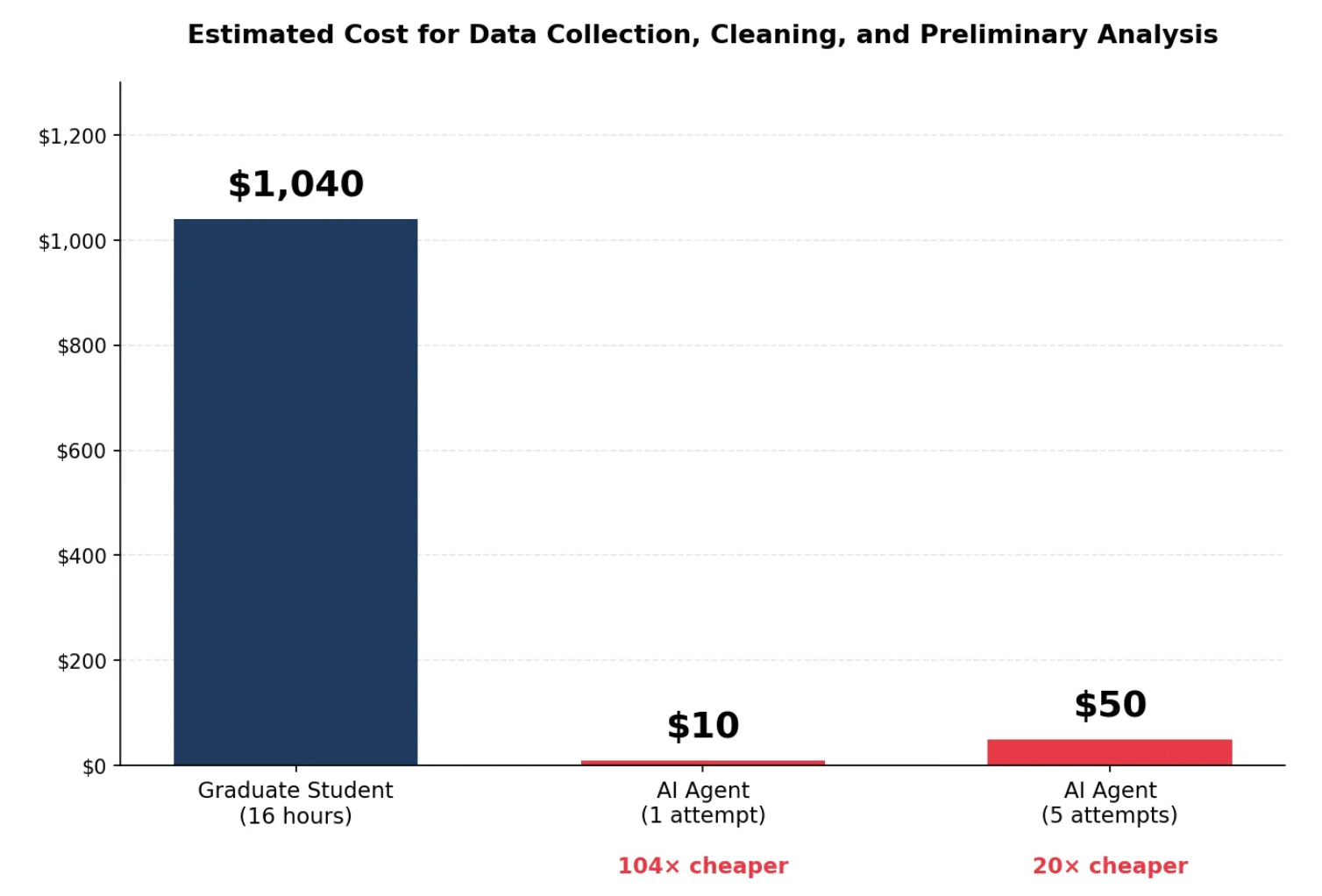
Andy Hall ran an experiment where he gave his 2020 vote-by-mail paper to Claude and asked it to replicate and extend the findings with new data. He then had a UCLA PhD student do the same work without AI assistance which provided a baseline to compare the results with. Claude’s output was very close – it correctly coded 29 of 30 California counties on treatment timing, and its collected data correlated above .999 with the manually gathered figures. Most importantly perhaps, despite the many mistakes, it finished within the hour, a task that otherwise took several days.
Hall uses this to build up to a broader institutional argument: “What would it mean to produce research with 100 times the scope of our vote-by-mail study? Not 100 times the length. 100 times the effort—because that’s what AI now makes plausible.”
Some applications are predictable – “more robustness checks, larger meta-analyses, deeper empirical exercises.” The more compelling idea is what he calls “living research” or empirical findings maintained as continuously updated infrastructure rather than static publications.
Hall’s other big vision culminates in a prototype he calls a “research swarm”: AI agents propose studies, an “LLM council” ranks them, agents execute the top candidates, and another LLM measures the output. Given how the economics of research have shifted, it is plausible to set-up this idea very cheaply.
There are almost certainly risks though and Hall flags three of them including a deluge of plausible-sounding but incorrect empirical work, incentive pressure toward small easily-verified studies crowding out ambitious ones, and massively scaled p-hacking as researchers can now search over huge spaces of possible analyses.

What we read
Material Science, Physics and Robotics (concrete advances outside of BioML):
Quo vadis biophotonics? Wearing serendipity and slow science as a badge of pride, and embracing biology [Schroeder-Turk, G.E., arXiv, Feb. 2026]
I will write about this article as the author wrote about science: from a first-person perspective and filled with passion, curiosity, and interest in the field of study. No LLM editing, raw.
Following on from last week’s theme of colour in biology, we are further diving into the field of biophotonics, this time with a funky opinionated article by G.E. Shroeder-Turk. Combining quotes from The Little Prince by Antoine de Saint-Exupéry with deep technical expertise on the field of biophotonics in the same texts, he argues for the need to understand biology in greater depth, beyond the ‘surface-level’ knowledge that suffices to allow for technological translation.
Consider the gyroid for example. A naturally occurring photonic crystal, a gyroid is what introduces the color green into some green-winged butterfly species. With a well-defined geometry, a gyroid can be fabricated synthetically in a bottom-up fashion using 3D printing, or in a top-down manner by templating nanostructures with polymers. Gyroids find use in optical sensors, photonic crystals, battery electrodes, bone tissue scaffolds, and filtration membranes - to name but a few applications. Effectively, the commercial use of the structure has not gone unnoticed. But what has - and what is a recurring pattern in the discovery and use of technology - is that commercial adoption often outpaces deep mechanistic understanding.
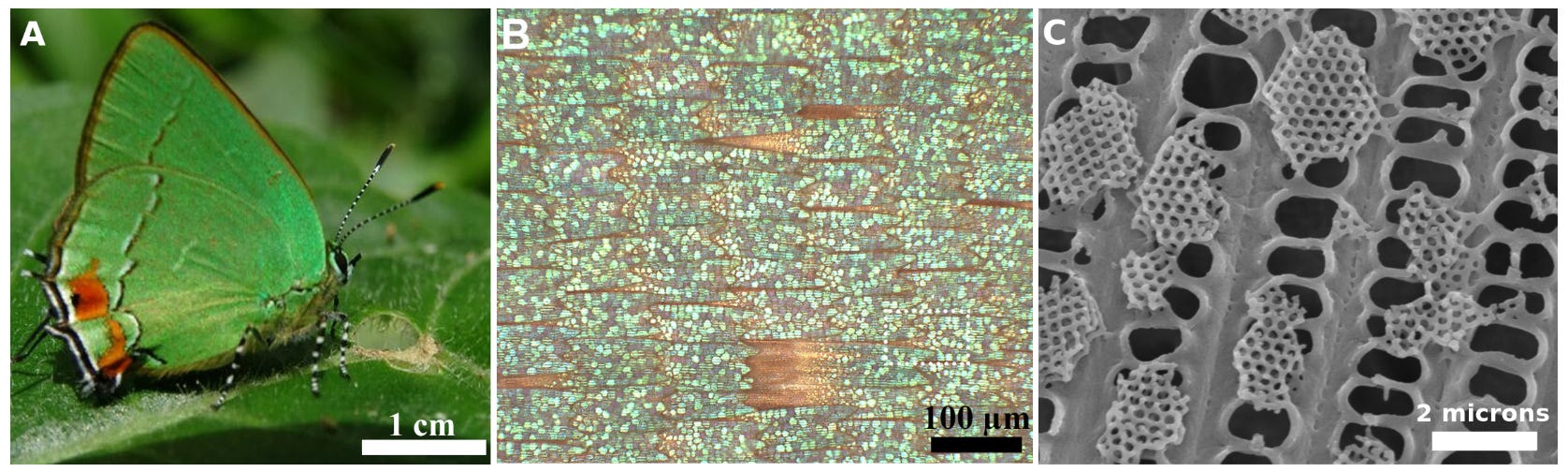
In the context of biophotonics, we can synthesize and replicate the biological curiosities nature has brought the field, but fail to understand the deep biological underpinnings of function and form. How does a butterfly wing grow? What mechanical stresses and consequential changes in gene expression do cells experience when forming a highly structured optically active geometry? And can we scaffold a mouse to grow butterfly wings - just as we tissue engineered it to grow a human ear? (1)
Three questions I was left wondering about post-article were:
1. Can we rethink how diagnostic sensors operate by having a direct conformational interaction with the material induce a color? (This question came from the reference discussed where direct interaction of a bacterium with silver induced a color change.)
2. What can we learn from how nature grows materials to either replicate the growth process, or use them directly by creating support structures to scale biology itself? (This question arose from the mention of using diatoms as ‘alternatives to cleanroom nanofabricated photonic crystals’.)
3. What other fields are similar to biophotonics in the sense of simply ‘stamp collecting’ new discoveries? Where do we leave data on the table that we could do more with, either by learning about the origin of how that ‘stamp’ came to be, or understanding the purpose and function of that ‘stamp’ in its wider biological context to be able to scale materials (towards the ultimate universal fabricator)?
I leave you to join the discussion in the comments, and close with the thought that biology is the deepest technology of all. So much more to discover.
Did we miss anything? Would you like to contribute to Decoding Science by writing a guest post? Drop us a note here or chat with us on X.