

Decoding Science 011: Adaptive sound-control devices, Criticism of Science Automation and LLMs Accelerate Scientific Dysfunctions


Welcome to Decoding Science: every other week our writing collective highlight notable news—from the latest scientific papers to the latest funding rounds in AI for Science —and everything in between. All in one place.

What we read
Please, don’t automate science! [Julian Togelius, December 2025]
Panelists at an AI for Science event at NeurIPS discussed plans to replace humans at all levels in the scientific process. Togelius argues that fully automating science (strong science automation) would be a profound mistake as it would strip humans from one of the deepest sources of meaning which is contributing to the growth of knowledge. He argues that even a faster cure to cancer in exchange for removing humans out of the loop in science is not worth it. Scientific progress guided by humans, in Togelius’ mind, is more valuable than accelerating outcomes.
Weak science automation, where AI acts as a tool that enhances human productivity and creativity, would be beneficial as it enhances human intellectual and creative work rather than making it obsolete. He also argues that if science experiences strong automation, merely making a hobby for humans, it would be a pretend version of advancing knowledge, not actually doing it.
Togelius says that full automation of science is not inevitable, and that we should be at the wheel making decisions; it is not an unstoppable train but a truck whose direction society can choose to steer.
Context Windows [Kevin Baker, Artificial Bureaucracy, Dec 2025]
Baker argues that the debate over whether LLMs can “do science” over-indexes on the “capabilities question.” Instead, we should be focusing on whether these models gel well with the scientific program that “was already running when they arrived.”
As many have pointed out, the current way of doing and sharing science is quite dysfunctional. Here, Baker traces this problem back to the 1960s, when we started quantifying science via citation metrics. These numbers were originally built to help researchers navigate exploding literature volumes but (predictably) morphed into signals of credit and endorsement. This represents what Robert Merton called “goal displacement,” the process by which the means become the ends.
The usual response to this issue invokes Goodhart’s Law: fix the corrupted measure with better measures. But Baker contends that this framing is insufficient. Goodhart says find a more robust indicator while Merton says the indicator is doing precisely what system design intends. Chasing new metrics ignores how measurement itself warps the relationship between good research and prestige.
With this context, we can appreciate how LLMs worsen the current dynamic by accelerating the “optimization machine.” We can now produce more stuff faster, the “paper-mill artifacts” that pollute the scientific commons. Baker notes that “one might hope that this acceleration heightens the contradictions, that the systems produce so much slop so quickly that the problem finally becomes undeniable.” But to truly avoid persisting in this state of dysfunction, we need “those who can build countervailing power, and who decide to change what gets measured, or finally wrench the institution of science itself from the false promise of measurement.”
Also see: Ben Recht’s response to Baker in Measures as Ends.

What we read
Combinatorial asymmetric acoustic metamaterials with real-time programmability [Melanie R. Keogh and Osama R. Bilal, Oct. 2025] - SC
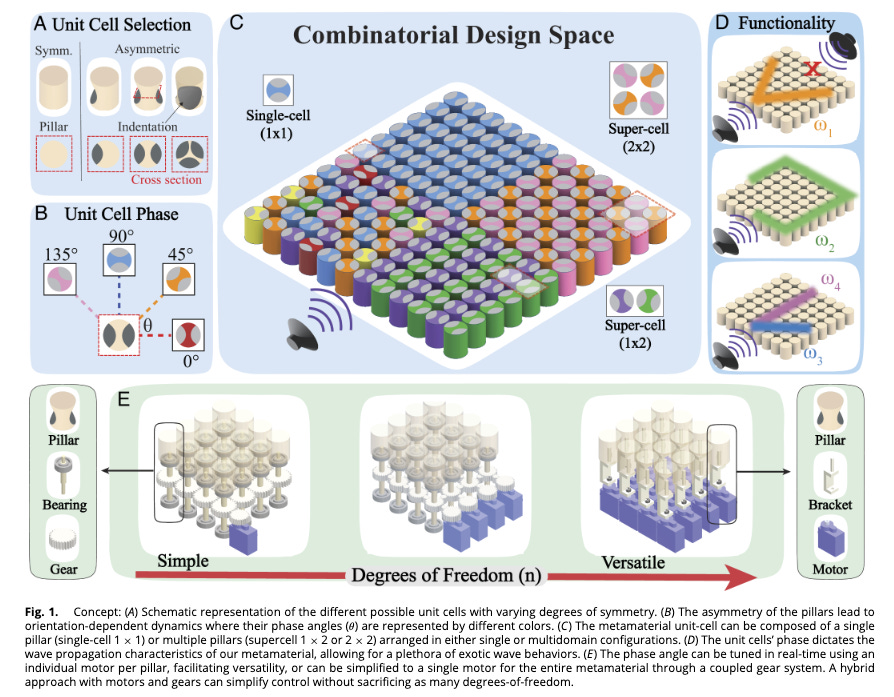
Sound control, much like heat management in electronics, often runs into a hard physical limitation: once acoustic metamaterials are fabricated, their geometry—and therefore their function—is fixed. This has long constrained their ability to adapt in real time. While tunable designs exist, achieving scalable, on-the-fly programmability has remained a major challenge.
Researchers at the University of Connecticut have now demonstrated a way around this, with a real-time programmable acoustic metamaterial built from asymmetric pillars with indentations that can rotate freely in the plane at any angle. Watch the video here shared by UConn! Instead of redesigning or refabricating the structure, the behavior of the material can be changed simply by rotating its components.
The impact of this approach is its sheer flexibility. Even a single unit cell, adjustable in 1° increments, yields 180 distinct configurations. When scaled to an array, this explodes into a design space exceeding 10¹⁰⁰ possible combinations—far beyond what conventional, static metamaterials can offer.
The team validated the concept through simulations and experiments using an 11×11 array of reprogrammable pillars. By rotating the pillars to different orientations, they demonstrated precise control over wave propagation: at 0° the structure strongly attenuated sound at predicted band-gap frequencies, while at 90° it allowed full transmission. They also showed topological insulator behavior by setting all pillars to 45°, forcing sound waves at 12.46 kHz to travel only along the edges without backscattering. Finally, by combining multiple orientation domains (0°, 45°, and 135°), they achieved diode-like, nonreciprocal sound propagation—blocking waves from one direction while allowing them from the other.
Together, these results highlight a shift from static acoustic materials to programmable platforms that can respond dynamically to their environment, opening the door to a new generation of adaptive sound-control devices.
Community & other links
SRPIN-D, the German innovation agency, is launching the “Next Frontier AI” initiative. They will support 10 teams for 2 years with up to EUR 125M in funding, and three of the teams have the potential to receive EUR 1B. The aim is to create European frontier AI labs.
Excelsior Sciences raised $95M to advance its AI-based chemical synthesis platform for small-molecule drugs.
Unconventional AI emerges from stealth with a $475M seed round. They develop energy-efficient computers for AI. Their architectural design takes inspiration from biology and the brain.
Medra secures $52M to develop physical AI scientists for drug discovery.
Field Trip
Did we miss anything? Would you like to contribute to Decoding Science by writing a guest post? Drop us a note here or chat with us on X.
 | A guest post by
|
You’re not using the brain as metaphor — you must look at what changes within. It’s not curiosity — it’s fact.
@lintara
Awesome work on the UConn metamaterial stuff. That 10^100 combination space is kinda wild when you think about it. I worked on a similr project with tunable photonic crystals, and the fabrication lock-in issue killed our flexibility every time. The rotating pillar design is such a clean soloution, feels almost obvious in hindsight but nobody'd done it before. Really curious how this scales up to 3D arrays tho, the edge-only propagation demo with the 45-degree orientation is prety slick for topological applications.